Changing Lives: From Pilot to University-wide Programme
Lady Margaret Hall Foundation Year documentary released
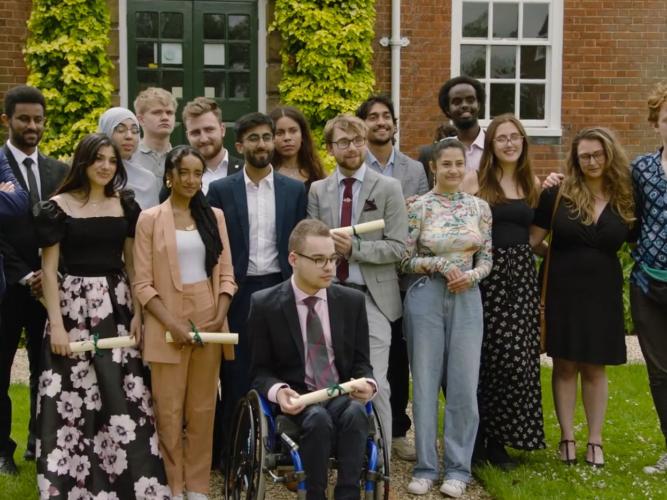
The Astrophoria Foundation Year builds on a pioneering access initiative first launched at Lady Margaret Hall in 2016. What began as a college-level pilot has since evolved into a University-wide programme, expanding access to Oxford for students whose academic potential may not be reflected in their grades alone.
The Astrophoria Foundation Year traces its origins to the Foundation Year established at Lady Margaret Hall (LMH) in 2016. The pilot programme was created to support talented students whose educational attainment had been shaped by disadvantage, disruption or limited opportunity.
Many participants were the first in their family to attend university. Some came from low-income households or schools with little history of progression to Oxford. Others had experienced significant personal challenges, including family hardship or undiagnosed learning differences. What united them was clear academic promise, coupled with circumstances that had constrained their attainment.
As one student reflected, "Oxford was something that always seemed quite unattainable for me."
The LMH Foundation Year provided a fully funded preparatory year, offering academic development, structured skills support and immersion in college life. Its purpose was not to lower standards, but to enable students to compete on equal terms. The programme recognised that grades alone do not always capture potential, particularly where educational opportunity has been uneven.
A senior academic involved in the pilot observed: "Maybe there are people of great potential who could easily have achieved top grades if they had a different kind of start in life."
The outcomes were significant. Students who might not otherwise have secured an Oxford place progressed to undergraduate study and flourished. Within a short period, Foundation Year students were academically indistinguishable from their peers. Many achieved first-class degrees and continued to postgraduate study, including at leading global institutions. Others have gone on to careers in research, public service and the creative industries.
As one graduate put it, "That is not dumbing down. If anything, that is adding to the excellence."
For many participants, the impact extended beyond academic achievement. Students spoke of arriving uncertain whether they would belong - as first-generation applicants, as students of colour, or as visibly Muslim women. Over time, that uncertainty gave way to confidence. "I need to be proud of where I've come from," one student reflected.
The programme's influence has also extended beyond the individuals directly involved. Participants have become advocates within their schools and communities, encouraging others to consider Oxford. Through outreach and social media, they have reached thousands of prospective applicants, helping to reshape perceptions of who Oxford is for.
The success of the LMH pilot provided clear evidence that contextual admissions strengthen, rather than dilute, academic excellence. It demonstrated that high potential exists across all backgrounds, and that with structured academic preparation and financial support, students thrive.
That evidence informed the creation of the Astrophoria Foundation Year: a University-wide programme designed to embed those principles at scale. Today, Astrophoria continues this commitment, identifying students whose education has been disrupted or disadvantaged and providing a fully funded year of academic preparation before progression to undergraduate study.
The journey from pilot to University-wide programme reflects a broader understanding that excellence and inclusion are mutually reinforcing. By widening access, Oxford strengthens its academic community and ensures that talent - wherever it is found - has the opportunity to succeed.
Watch the whole documentary on the Lady Margaret Hall YouTube channel