
Key information
| Entry qualifications | AAB |
|---|---|
| Course duration | 1 year |
| UCAS codes | Check the subject pathways |
| Admissions test | ESAT (Engineering Science options only) |
| Application deadline | 13th January 2027 |
| Contact us | If you have any questions about the Foundation Year in Chemistry, Engineering and Materials Science that we haven't answered, please visit our Q&A page on Slido (opens in a new window). |
About the course
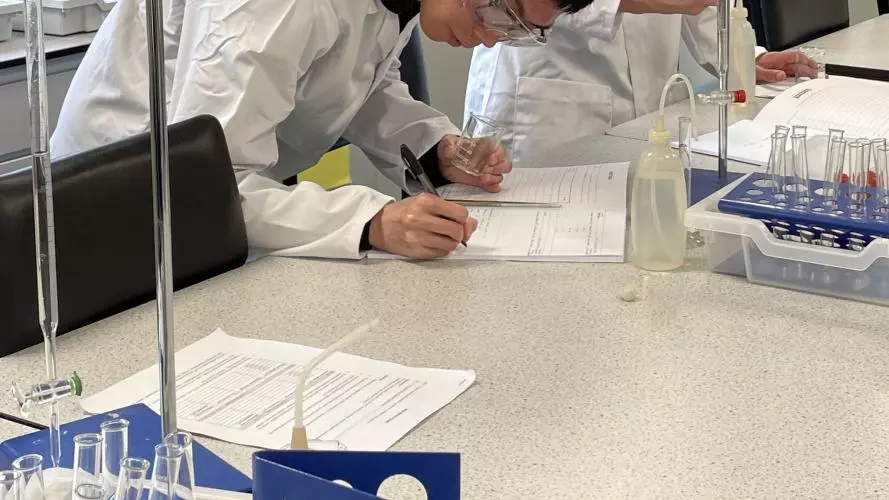
The Foundation Year in Chemistry, Engineering and Materials Science (CEMS) provides a strong grounding in core scientific and mathematical principles. The course places particular emphasis on building your confidence in applying knowledge, rather than simply acquiring it. Through problem-solving, laboratory work and an independent mini project, you will develop the skills needed to approach unfamiliar questions and work with increasing independence.
You will apply for a specific subject pathway, linked to the undergraduate degree you intend to study. These are:
- Chemistry with Foundation Year, the use of chemical and mathematical principles to explain the behaviour of atoms and molecules, and their physical and chemical properties.
- Engineering Science options*, with Foundation Year, applying mathematics and science to solve real-world problems
- Materials Science with Foundation Year, exploring how materials are structured, how they behave, and how they can be designed for different applications
Teaching during the Foundation Year is tailored to support your chosen pathway and prepare you for undergraduate study in that subject. All CEMS students follow a shared mathematics programme during the Foundation Year.
* For Engineering Science, the options on UCAS include: Biomedical, Chemical, Civil, Electrical, Engineering, Information or Mechanical Engineering, but all options share the same syllabus on the Foundation Year. This reflects the unified approach of the Engineering Science course at Oxford: all students study the same core content, building a broad foundation before specialising later in their undergraduate degree.
Preparation for Undergraduate Studies
Alongside your subject studies, you will take the Preparation for Undergraduate Studies course. This will help you develop core academic skills, including academic writing and communication skills, and opportunities for reflective practice, to support your progression to undergraduate level.
Entry requirements
Chemistry with Foundation Year
For Chemistry with Foundation Year, students are expected to have Chemistry and Mathematics to A-level (or any other accepted equivalent qualification). An additional science subject or further mathematics are also recommended.
The typical A-level entry requirements are AAB, with an A in Chemistry.
We do accept other types of qualifications. More information about the academic entry requirements and accepted qualifications is available on the Foundation Year in Chemistry, Engineering and Materials Science course page on the University of Oxford website.
Engineering Science options with Foundation Year
For all Engineering Science with Foundation Year pathways, students are expected to have Physics and Mathematics to A-level (or any other accepted equivalent qualification).
The typical A-level entry requirements are AAB, with an A in Physics.
We do accept other types of qualifications. More information about the academic entry requirements and accepted qualifications is available on the Foundation Year in Chemistry, Engineering and Materials Science course page on the University of Oxford website.
All applicants must take the Engineering and Science Admissions Test (ESAT) as part of their application.
Materials Science with Foundation Year
For Materials Science with Foundation Year, students are expected to have Physics and Mathematics to A-level (or any other accepted equivalent qualification). GCSE-level Chemistry is also required and Chemistry at A level is highly recommended.
The typical A-level entry requirements are AAB, with an A in either Physics or Maths or Chemistry is required
We do accept other types of qualifications. More information about the academic entry requirements and accepted qualifications is available on the Foundation Year in Chemistry, Engineering and Materials Science course page on the University of Oxford website.
Admissions test
| Engineering and Science Admissions Test (ESAT) | Taking the test in October 2026 | Taking the test in January 2027 |
|---|---|---|
| Test window | 12th to 16th October 2026 | 4th to 8th January 2027 |
| Registration opens | 1st June 2026, 3pm UK time | 5th October 2026, 3pm UK time |
| Test booking | 20th July to 28th September 2026, 6pm UK time | 26th October to 21st December 2026, 6pm UK time |
| Deadline for requesting access arrangements | 14th September 2026, 6pm UK time | 7th December 2026, 6pm UK time |
| Deadline for requesting a bursary | 21st September 2026, 6pm UK time | 14th December 2026, 6pm UK time |
All applicants for Engineering Science options with Foundation Year must take the Engineering and Science Admissions Test (ESAT) as part of their application. This must be taken before submitting your UCAS application and requires advance registration. This means that you should begin preparing your application earlier than in previous admissions cycles.
All applicants for Foundation Year in Engineering Science courses at Oxford University must take the following three modules:
- Mathematics 1
- Mathematics 2
- Physics
Foundation Year applicants can take the ESAT in either the October or January test window. Please visit the Admissions tests page on the University website for more information.
Visit the UAT-UK website for all information about:
- when and how to book your test appointment
- when and how to apply for access arrangements and bursaries
- how best to prepare for your test
- what to expect on the day of your test.
Bursaries for admissions tests
Candidates in financial need may be eligible for a bursary to cover the full cost of the ESAT admissions test. The bursary scheme is offered directly by UAT UK.
Bursaries are available for candidates who meet specific eligibility criteria, including applicants in receipt of Free School Meals, the 16–19 Bursary, or certain means-tested benefits. Supporting evidence is required as part of the application process. Applications for bursaries are made through your UAT-UK online account before booking your test.
- If you intend to take the test in October 2026, you must apply for a bursary by 21st September 2026, 6pm GMT.
- If you intend to take the test in January 2027, you must apply for a bursary by 14th December 2026, 6pm GMT.
Further information about eligibility and the application process is available on the UAT-UK bursary scheme website.
Subject pathways
Chemistry with Foundation Year
Chemistry is a wide-ranging science concerned with matter at the atomic and molecular scale.
You will study how substances are structured, how they react, and how their properties can be understood and controlled, drawing on areas such as synthesis, structure and reaction mechanisms. Advanced mathematics is also studied as this strongly supports the analysis and understanding of chemistry.
Chemistry with Foundation Year
Subject requirements
Maths and Chemistry at A-level (or equivalent)
Admissions test
Not required
Teaching staff

Dr Rachel Quarrell
"Chemistry is a brilliant subject, which overlaps with all the other sciences, and can lead to a wide range of careers. The Chemistry course will give students a solid understanding of why matter and molecules behave the way they do. This is crucial in drug design, green energy and technology, or explaining how the brain and body work. This course will also help students who have overcome difficult situations make the transition to university, with access to the libraries and labs of the University alongside support from experienced tutors."

Dr Sam Li Shen
"The Engineering subject pathways will allow students to consolidate their existing knowledge of Maths and Physics whilst developing their problem solving, laboratory and computing skills. This is an excellent way to prepare for the undergraduate Engineering degree."

Dr Chiheb Ben Mahmoud
“This is a subject that draws on multiple disciplines to help us understand and innovate with the materials that shape our world. The Foundation Year is a great opportunity to build confidence and skills across science and engineering.”